The Last Train Home: A Short Story About Choices, Regret, and Hope
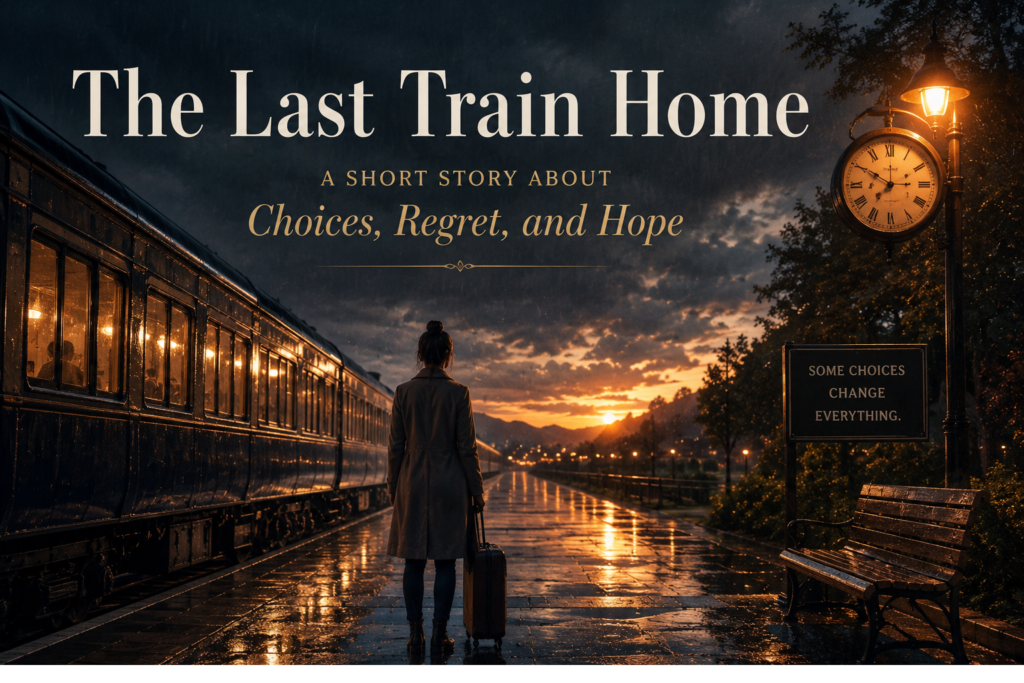
The station clock read 11:47 p.m.
Daniel stood alone on Platform 4, holding a small suitcase in one hand and an old photograph in the other.
The last train home was scheduled to leave in thirteen minutes.
For almost ten years, he had avoided coming back to his hometown.
Tonight, he wasn’t sure whether he was ready to return.
The station was nearly empty. A few lights flickered above the platform, and the sound of rain tapping against the roof filled the silence.
Daniel looked at the photograph again.
It showed three people standing outside a small house.
His father.
His mother.
And Daniel, much younger, smiling between them.
He hadn’t seen the photograph in years.
He had found it that afternoon while cleaning out his apartment.
That’s when he received the message.
“Your mother is asking for you.”
Daniel had stared at those words for several minutes.
He hadn’t spoken to his mother in eight years.
Not because he didn’t love her.
Because he had been angry.
Very angry.
And over time, anger had become easier than forgiveness.
The Choice
When Daniel was twenty-three, he had left home after a terrible argument with his father.
His father wanted him to stay in town and take over the family business.
Daniel wanted to leave.
He wanted to study music in the city.
They argued.
Words were exchanged.
Daniel packed a bag and walked out.
His mother had followed him to the front gate.
“Please don’t leave like this,” she had begged.
Daniel remembered turning around.
“I’ll come back when he apologizes.”
His mother had tears in her eyes.
“Don’t wait too long.”
But Daniel did.
His father never apologized.
Daniel never returned.
Months became years.
His father eventually passed away.
Daniel didn’t attend the funeral.
He told himself he couldn’t face the memories.
Now, eight years later, his mother was asking for him.
And he was standing at the station with thirteen minutes to decide whether to go home.
The Train Arrives
At 11:58 p.m., headlights appeared in the distance.
The train was coming.
Daniel looked at his suitcase.
Then at the photograph.
Then toward the road leading away from the station.
He could still leave.
Nobody was forcing him onto that train.
But something inside him whispered:
Go home.
The train stopped.
The doors opened.
Daniel stepped inside.
The Empty Seat
The train was almost empty.
Daniel found a seat near the window.
Across the aisle sat an elderly woman holding a small bouquet of flowers.
She looked at Daniel’s suitcase.
“Going somewhere?” she asked.
Daniel smiled.
“Home.”
The woman nodded.
“That’s usually the most important place to go.”
Daniel looked out the window.
The train began moving.
Buildings passed slowly outside.
Rain covered the glass.
For the first time in years, Daniel wondered what his mother would say when she saw him.
Would she be angry?
Would she forgive him?
Would she even want him there?
He didn’t know.
And that uncertainty frightened him.
The Stranger’s Question
After several minutes, the woman across from him spoke again.
“Are you afraid?”
Daniel looked at her.
“A little.”
“Of what?”
Daniel thought about it.
“Regret.”
The woman smiled sadly.
“Regret is strange.”
“Why?”
“Because we often regret the things we didn’t do more than the things we did.”
Daniel looked down at the photograph in his hands.
“My father and I had a fight years ago.”
The woman waited.
“I never went back.”
“Why?”
“He was supposed to apologize.”
“And did he?”
Daniel shook his head.
“He died before he could.”
The woman looked out the window.
“Then perhaps you have been waiting for an apology that can no longer come.”
Daniel felt a lump in his throat.
“Maybe.”
She looked at him.
“Don’t let one unfinished conversation become your entire life.”
The Message
Daniel’s phone vibrated.
He looked at the screen.
It was his mother.
“Are you coming?”
His fingers hovered above the keyboard.
He typed:
“Yes.”
Then he pressed send.
Almost immediately, another message appeared.
“I’m waiting.”
Daniel stared at those two words.
I’m waiting.
He had spent eight years thinking that he was the only one hurt.
He had never stopped to consider that his mother might have been waiting all that time too.
The Old Station
The train arrived at Daniel’s hometown shortly after midnight.
He stepped onto the platform.
Everything looked smaller than he remembered.
The old bakery was still there.
The streetlights were the same.
Even the station sign had the same faded letters.
Daniel walked toward the exit.
Then he stopped.
His mother was standing outside.
She looked older.
Her hair was almost completely gray.
For several seconds, neither of them moved.
Then she smiled.
Daniel dropped his suitcase.
“Mom.”
She walked toward him.
He expected anger.
Instead, she hugged him.
Daniel closed his eyes.
For the first time in years, he allowed himself to cry.
“I’m sorry,” he whispered.
His mother held him tighter.
“So am I.”
The House
They walked home together.
The house looked almost exactly as Daniel remembered it.
His childhood bicycle was still hanging in the garage.
His old room still had the faded posters on the walls.
And in the kitchen was the wooden table where he and his father had shared thousands of meals.
Daniel stood there silently.
His mother placed a cup of tea in front of him.
“Your father used to sit there,” she said.
Daniel looked at the empty chair.
“I know.”
She sat beside him.
“He asked about you often.”
Daniel swallowed.
“He did?”
“Every birthday. Every Christmas.”
Daniel looked down.
“Why didn’t you tell me?”
“Because you were angry.”
His mother paused.
“And I thought you would come back when you were ready.”
Daniel closed his eyes.
“I thought he didn’t want me.”
His mother reached across the table and held his hand.
“He always wanted you.”
That sentence broke something inside him.
Something he had been carrying for years.
The Letter
Later that night, his mother gave Daniel an envelope.
“Your father left this for you.”
Daniel stared at it.
His name was written across the front.
His hands trembled as he opened it.
Inside was a short letter.
Daniel,
I don’t know if you will ever read this.
I was angry when you left, but I was also proud of you for wanting something different. I didn’t know how to say that.
I wanted you to stay because I was afraid of losing you.
Maybe I pushed you away because I was afraid of letting you go.
If you ever come home, I hope you understand that I loved you even when I didn’t know how to show it.
Your father.
Daniel read the letter twice.
Then he placed it against his chest.
His mother sat beside him.
Neither spoke.
They didn’t need to.
A New Morning
Daniel stayed.
One night became a week.
A week became a month.
He began helping his mother around the house.
He also started playing music again.
The old piano in the living room was covered in dust.
Daniel cleaned it.
Then he sat down.
His fingers touched the keys.
The first notes were hesitant.
Then stronger.
His mother stood in the doorway listening.
“You used to play that song all the time,” she said.
Daniel smiled.
“I remember.”
Outside, the sun was rising.
For the first time in years, Daniel didn’t feel like he was running away from something.
He felt like he was moving toward something.
The Last Train
Months later, Daniel returned to the station.
He stood on Platform 4 and watched another late-night train disappear into the distance.
He thought about the night he had almost chosen not to board.
If he had walked away, he might never have heard his father’s final words.
He might never have forgiven himself.
He might never have discovered that his mother had been waiting all those years.
Daniel smiled.
Sometimes one decision can change everything.
Not because it erases the past.
But because it gives you a chance to stop carrying it.
Final Thoughts
Life is filled with choices.
Some are small.
Some change everything.
And sometimes, we don’t realize the importance of a choice until years later.
Daniel spent eight years waiting for an apology that never came.
He believed returning home would mean admitting that he had been wrong.
Instead, he discovered something more important.
Coming home wasn’t about deciding who was right or wrong.
It was about choosing love over pride.
It was about accepting that people can hurt each other while still loving one another.
And most importantly, it was about understanding that forgiveness doesn’t always change the past.
Sometimes, it simply gives the future a chance.
If you’re holding onto anger, regret, or an unfinished conversation, remember Daniel’s journey.
You may not be able to change what happened yesterday.
But you can choose what happens next.
And sometimes, the bravest thing you can do is get on the train and go home.